A Two-Minute Review of the Day That Helps Tomorrow
A two-minute review of the day helps separate events from assumptions, so you can carry one useful observation into tomorrow without judging yourself.
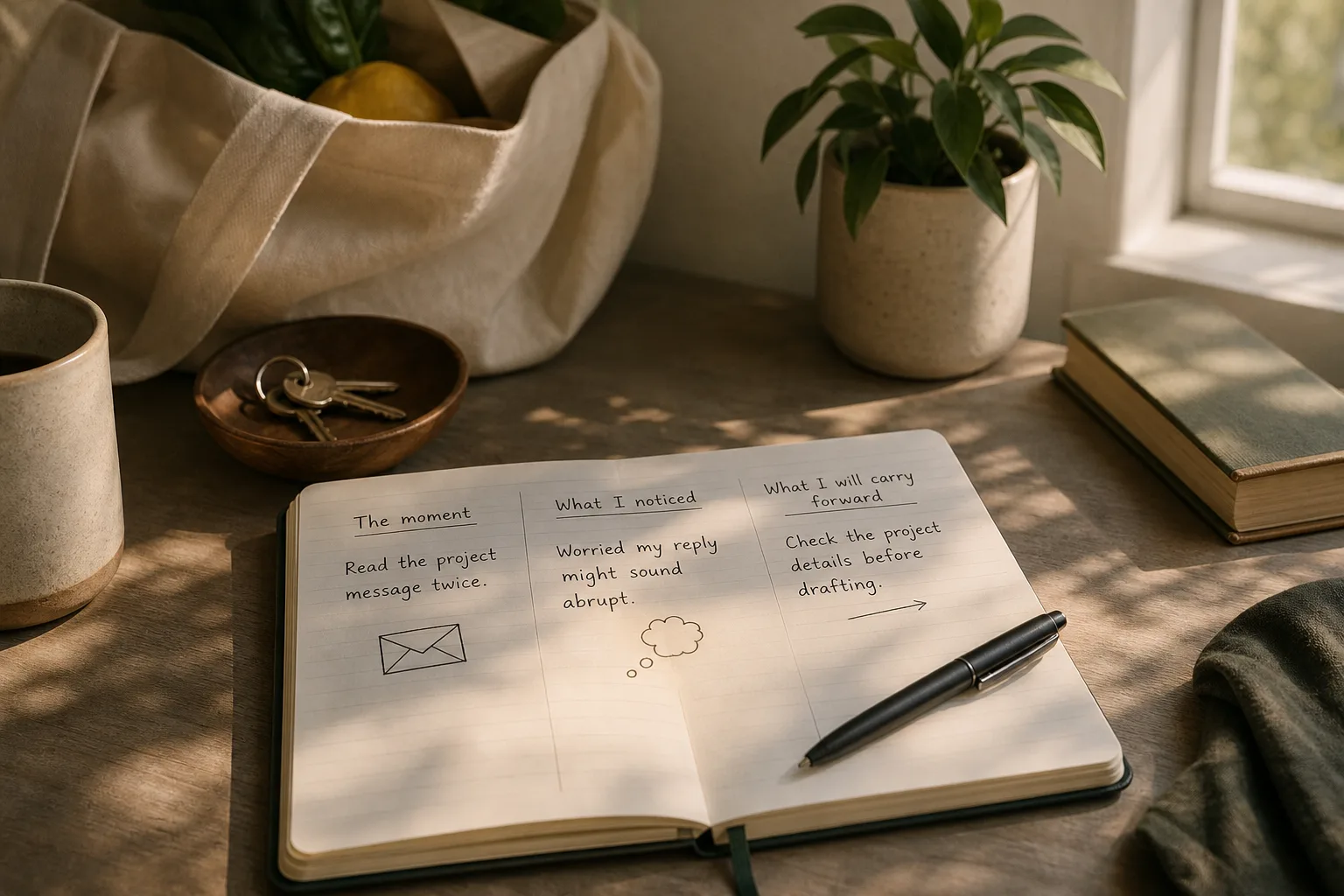
You place your keys beside a grocery bag, then remember the message you left unanswered before dinner. A two-minute review of the day can give that moment a small, clear place on the page without asking it to explain your whole character.
The practice is deliberately modest: record one scene, notice your response, and decide whether anything deserves attention tomorrow. It is not a way to inspect every choice or extract a lesson from every evening.
A two-minute review of the day stays with one scene
Choose a moment you can recall without searching for the day’s most important event. It might be a pause before answering a question, a decision to postpone an errand, or a conversation that stayed with you on the walk home.
Write what happened in plain terms, then add what you noticed in yourself. “I read the message twice before replying” describes a scene; “I never communicate well” turns that scene into a judgment. A brief reflection works best when it keeps its attention on the particular moment.
Think of the note as a small tray for setting down a thought while you look at it. You can keep what is useful and leave the rest there; nothing in the exercise requires a conclusion.
Three short lines keep the practice contained
Use a pocket notebook or a saved phone note. Give each prompt one line, and stop when you have answered it plainly:
- The moment: What happened that I could describe to another person?
- What I noticed: What did I feel, think, hesitate over, or do?
- What I will carry forward: Is there a question or small action worth remembering, or is there no decision tonight?
Say you opened a work message before dinner, reread it, and did not reply. Your starting details are the message, the rereading, and the delay. You write “Read the project message twice,” then “Worried my reply might sound abrupt,” then “Check the project details before drafting.” The visible result is a note that records one event, one concern, and one manageable next move; it does not claim to know how anyone will respond.
If nothing needs doing, write “no decision tonight.” That keeps the review from inventing a task just to make the page feel complete.
Check each line before carrying it into tomorrow
Use these checks to decide what to keep, revise, or leave open. Each one concerns the note, not whether you handled the day correctly.
- Look for a scene: If the line names something you saw, heard, or did, keep it; if it says “I ruin everything,” replace that label with the particular moment you remember.
- Look for an unmarked conclusion: If the note says what you feared or guessed, mark it as a thought; if it gives a concrete detail, leave the detail as written.
- Look for room in the account: If another explanation could fit, write that possibility beside the first; if you lack the information to tell, leave the question open instead of choosing a story.
- Look for a choice that was yours: If you can name a specific action you took, record it; if the outcome depended on another person or an outside circumstance, do not turn the outcome into a judgment about yourself.
- Look at the proposed next move: If you can name a small action, such as checking a document or drafting a question, keep it; if the action remains vague or feels too large, write the question you still have instead.
- Notice how writing affects you: If the note helps you settle the scene, finish and put it away; if writing intensifies distress, stop the exercise and consider talking with someone you trust or a qualified professional if that would be helpful.
Questions about a brief evening reflection?
What if nothing stands out from the day?
Write “nothing stands out” and stop there. A reflection does not need to produce an insight or action every evening.
How can I keep a note from becoming self-criticism?
Describe the moment before naming what it says about you. If a sentence makes a broad claim about your character, replace it with the specific action or conversation that prompted the thought.
Do I need to act on every observation?
No. Some notes are useful simply because they record what caught your attention. Choose an action only when it is clear and worth carrying into the next day.
What if the concern feels too large for this exercise?
End the review rather than trying to resolve a difficult concern in a few lines. If it remains hard to manage, talking with someone you trust or a qualified professional may be appropriate.
A worked note can stay specific without settling everything
Imagine you planned to call a friend, noticed the time only after dinner, and felt disappointed that the call did not happen. Start with those three details: the planned call, the late glance at the clock, and the disappointment. Write them as separate observations rather than as proof that you are unreliable.
Next, note what remains unknown: you have not yet decided whether you forgot, avoided the conversation, or became occupied with something else. If you still want to talk, write “send a message asking about another time”; if you are unsure, write “decide tomorrow whether I want to call.” The resulting note offers two distinct choices and a clear condition for each, without forcing an explanation the evening cannot supply.
Keep the entry in one place and date it so you can remember its setting. A two-minute review of the day is most useful when it stays small: one scene, a fair account of your response, and either a next move or permission to leave the matter open.